| Home | > | List of families | > | Pteridaceae | > | Actiniopteris | > | radiata |
Actiniopteris radiata
Selected images: Click on each image to see a larger version and details of the record View all images (6)
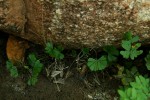
Photo: Petra Ballings
Birchenough bridge to Masvingo road, near Nyika
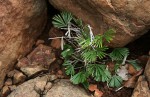
Photo: Petra Ballings
Tuli camp on road to police camp
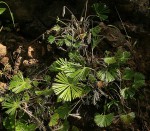
Photo: Petra Ballings
Road from Robins camp to main Hwange - Vic Falls road, Matetsi bridge
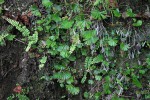
Photo: Petra Ballings
Hippo Pools, Umfurudzi Safari Area
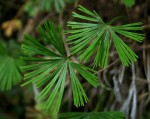
Photo: Petra Ballings
Hippo Pools, Umfurudzi Safari Area
Detailed records: Display species records QDS maps by: Google Maps Point records by Google Maps
Species details: Click on each item to see an explanation of that item (Note: opens a new window)
| Synonyms: |
Acrostichum radiatum (J.König ex Sw.) Poir. Actiniopteris australis sensu Sim Asplenium radiatum J.König ex Sw. Pteris radiata (J.König ex Sw.) Bojer |
| Common names: | |
| Frequency: | |
| Status: | Native |
| Description: |
Rhizome shortly creeping, c. 4 mm in diameter; rhizome scales narrowly triangular, pale brown with a central dark stripe, 3-3.5 mm long. Stipe pale brown to strawcoloured, subglabrous with few brown hairlike scales. Fronds densely tufted, erect, weakly dimorphic, differing only in size and stipe length not in shape and degree of lamina dissection. Lamina flabellate, semi-circular in outline, dried lamina bent over sharply at an angle of 90° or more with the stipe. Sterile frond: stipe 2-10 cm long, lamina 1.5-4.5 cm long, dichotomously divided into 20-60 linear segments, segments apices serrate with 2-5 teeth, margins entire, usually reflexed. Fertile frond: stipe 5.5-20 cm long, lamina 3-7 cm long, otherwise similar to sterile lamina. Sori in submarginal lines, partly obscured by reflexed margin; indusium continuous. |
| Notes: | Can be confused with Actiniopteris dimorpha. A. dimorpha is strongly dimorph, fertile and sterile fronds differing in size and stipe length, as well as in shape or degree of lamina dissection. A. dimorpha also has about half the number of segments on the fertile frond. |
| Derivation of specific name: | radiata: describing the radiating arrangement of the segments of the lamina. |
| Habitat: | Dry rocky outcrops, in rock crevices, at base of boulders, on shallow soil overlying sheetrock, earth banks in shaded ravines. |
| Altitude range: | 500 - 1300 m |
| Worldwide distribution: | Southern Africa, throughout tropical Africa westwards to the Cape Verde Is. and eastwards through Arabia to India and Sri Lanka. |
| Mozambique distribution: | MS |
| Growth form(s): | Lithophyte, terrestrial. |
| Endemic status: | |
| Red data list status: | |
| Insects associated with this species: | |
| Spot characters: | Display spot characters for this species |
| Literature: |
Burrows, J.E. (1990). Southern African Ferns and Fern Allies. Frandsen, Sandton. Page 180. (Includes a picture). Burrows, J.E. & Burrows, S.M. (1993). An annotated check-list of the pteridophytes of Malawi Kirkia 14(1) Page 89. Chapano, C. & Mamuto, M. (2003). Plants of the Chimanimani District National Herbarium and Botanic Garden, Zimbabwe Page 2. Crouch, N.R., Klopper, R.R., Burrows, J.E. & Burrows, S.M. (2011). Ferns of Southern Africa, A comprehensive guide Struik Nature Pages 306 - 307. (Includes a picture). Da Silva, M.C., Izidine, S. & Amude, A.B. (2004). A preliminary checklist of the vascular plants of Mozambique. Southern African Botanical Diversity Network Report No. 30 Sabonet, Pretoria Page 13. Germishuizen, G. & Meyer, N.L. (eds) (2003). Plants of southern Africa: an annotated checklist. Strelitzia 14 Page 80. Jacobsen, W.B.G. (1983). The Ferns and Fern Allies of Southern Africa. Butterworths, Durban and Pretoria. Pages 291 - 292. (Includes a picture). Kornas, J. (1979). Distribution and ecology of the Pteridophytes in Zambia Polska Akademia Nauk Wydzial II Nauk Biologicznych Pages 46 - 47. Mapaura, A. & Timberlake, J. (eds) (2004). A checklist of Zimbabwean vascular plants Southern African Botanical Diversity Network Report No. 33 Sabonet, Pretoria and Harare Page 9. Pickering, H. & Roe, E. (2009). Wild Flowers of the Victoria Falls Area Helen Pickering, London Page 116. (Includes a picture). Roux, J.P. (2001). Conspectus of Southern African Pteridophyta. Southern African Botanical Diversity Network Report 13 Page 59. (Includes a picture). Roux, J.P. (2009). Synopsis of the Lycopodiophyta and Pteridophyta of Africa, Madagascar and neighbouring islands Pages 167 - 168. Schelpe, E.A.C.L.E. (1970). Pteridophyta Flora Zambesiaca Page 138. (Includes a picture). Setshogo, M.P. (2005). Preliminary checklist of the plants of Botswana. Sabonet Report no. 37. Sabonet, Pretoria and Gaborone Page 15. |
Other sources of information about Actiniopteris radiata:
Our websites:
Flora of Botswana: Actiniopteris radiataFlora of Malawi: Actiniopteris radiata
Flora of Zambia: Actiniopteris radiata
Flora of Zimbabwe: Actiniopteris radiata
External websites:
African Plants: A Photo Guide (Senckenberg): Actiniopteris radiataAfrican Plant Database: Actiniopteris radiata
BHL (Biodiversity Heritage Library): Actiniopteris radiata
EOL (Encyclopedia of Life): Actiniopteris radiata
GBIF (Global Biodiversity Information Facility): Actiniopteris radiata
Google: Web - Images - Scholar
iNaturalist: Actiniopteris radiata
IPNI (International Plant Names Index): Actiniopteris radiata
JSTOR Plant Science: Actiniopteris radiata
Mansfeld World Database of Agricultural and Horticultural Crops: Actiniopteris radiata
Plants of the World Online: Actiniopteris radiata
Tropicos: Actiniopteris radiata
Wikipedia: Actiniopteris radiata
| Home | > | List of families | > | Pteridaceae | > | Actiniopteris | > | radiata |