| Home | > | List of families | > | Linderniaceae | > | Lindernia | > | parviflora |
Lindernia parviflora
Selected images: Click on each image to see a larger version and details of the record View all images (12)
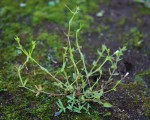
Photo: Bart Wursten
Manager's compound, SDH Tea Estates, Gurue
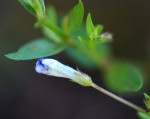
Photo: Bart Wursten
Manager's compound, SDH Tea Estates, Gurue
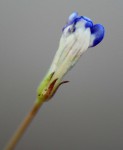
Photo: Bart Wursten
Manager's compound, SDH Tea Estates, Gurue
Detailed records: Display species records QDS maps by: Google Maps Point records by Google Maps
Species details: Click on each item to see an explanation of that item (Note: opens a new window)
| Synonyms: |
Gratiola parviflora Roxb. Ilysanthes capensis (Thunb.) Benth. Ilysanthes parviflora (Roxb.) Benth. Ilysanthes radicans Pilg. Lindernia capensis Thunb. |
| Common names: | |
| Frequency: | |
| Status: | Native |
| Description: |
Erect, decumbent or ascending annual herb, 5-25 cm tall but usually smaller. Stems hairless or slightly pubescent, diffusely branched. Leaves opposite, mostly sessile, very variable, ovate, lanceolate or elliptic, 2-20 mm long, rarely longer, rounded or pointed at the apex; margin entire or sometimes shallowly toothed in larger leaves. Flowers axillary or in terminal racemes. Pedicel slender, 5-12 mm long, longer in fruit. Calyx 2-4 mm long, divided almost to the base into linear-lanceolate lobes. Corolla white to pale blue with darker blue markings, 3-12 mm long; upper lip shallowly emarginate or bifid; lower lip 3-lobed. Stamens 4 with 2 fertile. Capsule obovate-ellipsoid or subglobose, up to 4 × 3 mm. |
| Notes: | This species is quite variable in size and leaf shape. In our area the mostly pale coloured, more tubular flowers with smaller lobes are typical for this species. |
| Derivation of specific name: | parviflora: small-flowered |
| Habitat: | In muddy or sandy soil along streams, rivers pans and floodplains or in and around seasonal pools on rock outcrops, often in secondary or disturbed areas. |
| Altitude range: | Up to 1450 m |
| Flowering time: | |
| Worldwide distribution: | Widespread in tropical Africa, South Africa, Madagascar, Sri Lanka, India and Vietnam. |
| Mozambique distribution: | Z,GI,M |
| Growth form(s): | |
| Endemic status: | |
| Red data list status: | |
| Insects associated with this species: | |
| Spot characters: | Display spot characters for this species |
| Content last updated: | Friday 8 June 2012 |
| Literature: |
Chapano, C. & Mugarisanwa, N.H. (2003). Plants of the Matobo District National Herbarium and Botanic Garden, Zimbabwe Page 24. Fischer, E. (1992). Systematik der afrikanischen Lindernieae (Scrophulariaceae) Tropische und subtropische Pflanzenwelt 81 Pages 312 - 316. (Includes a picture). Ghazanfar, S.A., Hepper, F.N. & Philcox, D. (2008). Scrophulariaceae Flora of Tropical East Africa Pages 83 - 84. (Includes a picture). Mapaura, A. & Timberlake, J. (eds) (2004). A checklist of Zimbabwean vascular plants Southern African Botanical Diversity Network Report No. 33 Sabonet, Pretoria and Harare Page 78. Philcox, D. (1990). Scrophulariaceae Flora Zambesiaca 8(2) Page 69. Phiri, P.S.M. (2005). A Checklist of Zambian Vascular Plants Southern African Botanical Diversity Network Report No. 32 Page 98. Setshogo, M.P. (2005). Preliminary checklist of the plants of Botswana. Sabonet Report no. 37. Sabonet, Pretoria and Gaborone Page 104. |
Other sources of information about Lindernia parviflora:
Our websites:
Flora of Botswana: Lindernia parvifloraFlora of Caprivi: cultivated Lindernia parviflora
Flora of Malawi: Lindernia parviflora
Flora of Zambia: Lindernia parviflora
Flora of Zimbabwe: Lindernia parviflora
External websites:
African Plants: A Photo Guide (Senckenberg): Lindernia parvifloraAfrican Plant Database: Lindernia parviflora
BHL (Biodiversity Heritage Library): Lindernia parviflora
EOL (Encyclopedia of Life): Lindernia parviflora
GBIF (Global Biodiversity Information Facility): Lindernia parviflora
Google: Web - Images - Scholar
iNaturalist: Lindernia parviflora
IPNI (International Plant Names Index): Lindernia parviflora
JSTOR Plant Science: Lindernia parviflora
Mansfeld World Database of Agricultural and Horticultural Crops: Lindernia parviflora
Plants of the World Online: Lindernia parviflora
Tropicos: Lindernia parviflora
Wikipedia: Lindernia parviflora
| Home | > | List of families | > | Linderniaceae | > | Lindernia | > | parviflora |