| Home | > | List of families | > | Rubiaceae | > | Agathisanthemum | > | bojeri |
Agathisanthemum bojeri[Agg]
Selected images: Click on each image to see a larger version and details of the record View all images (23)
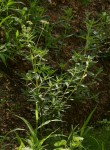
Photo: Bart Wursten
Road from EN1 to Gorongosa National Park entrance gate
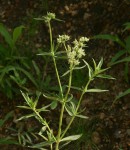
Photo: Bart Wursten
Road from EN1 to Gorongosa National Park entrance gate
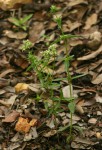
Photo: Bart Wursten
Road from EN1 to Gorongosa National Park entrance gate
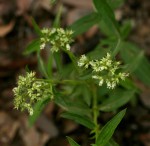
Photo: Bart Wursten
Road from EN1 to Gorongosa National Park entrance gate
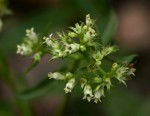
Photo: Bart Wursten
Road from EN1 to Gorongosa National Park entrance gate
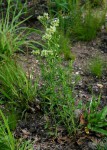
Photo: Bart Wursten
At turn-off from EN1 to Gorongosa National Park, Mozambique
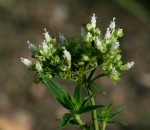
Photo: Bart Wursten
At turn-off from EN1 to Gorongosa National Park, Mozambique
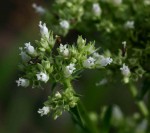
Photo: Bart Wursten
At turn-off from EN1 to Gorongosa National Park, Mozambique
Detailed records: Display species records QDS maps by: Google Maps Point records by Google Maps
Species details: Click on each item to see an explanation of that item (Note: opens a new window)
| Synonyms: |
Agathisanthemum angolense Bremek. Agathisanthemum bojeri Klotzsch subsp. australe Bremek. Oldenlandia bojeri (Klotzsch) Hiern |
| Common names: | |
| Frequency: | Frequent |
| Status: | Native |
| Description: |
Branched, shrubby perennial herb, 25-150 cm tall. Young stems densely velvety, becoming hairless when older, often with brownish bark peeling off. Leaves opposite but often appearing whorled due to short, undeveloped shoots at most nodes, subsessile, narrowly lanceolate-elliptic to ovate-oblong, 1.2-6 cm long, hairless or slightly rough above, velvety on the veins beneath. Stipules finely velvety, sheath-like, up to 4.5 mm long with up to 5 fimbriae, 1-6 mm long. Inflorescences in more or less lax branched terminal heads, although individual clusters within the inflorescence may be quite dense. Flowers distinctly heterostylous. Calyx lobes 1-3.5 mm long. Corolla white, creamy or greenish-white 2.5-5 mm long. Style 1-2 mm long in short-styled flowers, 3-5 mm long in long-styled flowers. Capsule 1-3 mm long. |
| Notes: | We created an aggregate as 2 subspecies exist in most of Southern Africa, which are only separable with great difficulty. Since only subsp. bojeri is said to occur in Mozambique, one could assign all records to this subspecies but certain reservation should probably be applied when specimens are found at higher altitudes and much further inland. The following may help to distinguish the two (Verdcourt, 1989 in FZ 5-1: 108-110):
|
| Derivation of specific name: | bojeri: after Wenceslas Bojer (1795/1797-1856), Czech naturalist, horticulturist and botanist at the Imperial Museum at Vienna who collected extensively in Mauritius, Madagascar, Comoro Islands and on the East coast of Africa. |
| Habitat: | Various types of woodland, grassland, riverine forest and as a weed in old cultivated fields, often on sandy soils. |
| Altitude range: | Up to 1500 m |
| Flowering time: | |
| Worldwide distribution: | Angola, DRC, Somalia, Kenya, Tanzania, Mozambique, Zambia, Zimbabwe, Eswatini, South Africa, Comoro Islands and Madagascar. |
| Mozambique distribution: | N,Z,MS,GI,M |
| Growth form(s): | |
| Endemic status: | |
| Red data list status: | |
| Insects associated with this species: | |
| Spot characters: | Display spot characters for this species |
| Content last updated: | Monday 3 October 2011 |
| Literature: |
Chapano, C. & Mugarisanwa, N.H. (2003). Plants of the Matobo District National Herbarium and Botanic Garden, Zimbabwe Page 3. Da Silva, M.C., Izidine, S. & Amude, A.B. (2004). A preliminary checklist of the vascular plants of Mozambique. Southern African Botanical Diversity Network Report No. 30 Sabonet, Pretoria Page 99. Mapaura, A. & Timberlake, J. (eds) (2004). A checklist of Zimbabwean vascular plants Southern African Botanical Diversity Network Report No. 33 Sabonet, Pretoria and Harare Page 71. Phiri, P.S.M. (2005). A Checklist of Zambian Vascular Plants Southern African Botanical Diversity Network Report No. 32 Page 86. Verdcourt, B. (1988). Rubiaceae, Part 1 Flora Zambesiaca 5(1) Pages 108 - 109. (Includes a picture). |
Other sources of information about Agathisanthemum bojeri:
Our websites:
Flora of Zambia: Agathisanthemum bojeriFlora of Zimbabwe: Agathisanthemum bojeri
External websites:
African Plants: A Photo Guide (Senckenberg): Agathisanthemum bojeriBHL (Biodiversity Heritage Library): Agathisanthemum bojeri
EOL (Encyclopedia of Life): Agathisanthemum bojeri
GBIF (Global Biodiversity Information Facility): Agathisanthemum bojeri
Google: Web - Images - Scholar
iNaturalist: Agathisanthemum bojeri
IPNI (International Plant Names Index): Agathisanthemum bojeri
JSTOR Plant Science: Agathisanthemum bojeri
Mansfeld World Database of Agricultural and Horticultural Crops: Agathisanthemum bojeri
Plants of the World Online: Agathisanthemum bojeri
Tropicos: Agathisanthemum bojeri
Wikipedia: Agathisanthemum bojeri
| Home | > | List of families | > | Rubiaceae | > | Agathisanthemum | > | bojeri |