Osteospermum monocephalum
Selected images: Click on each image to see a larger version and details of the record View all images (5)
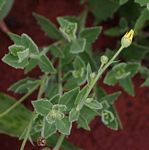
Photo: Bart Wursten
Mtoroshanga Pass, Gt Dyke
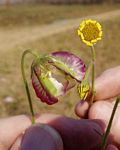
Photo: Mark Hyde
Headlands by Harare / Mutare Rd
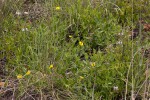
Photo: Bart Wursten
Kopje Tops, Mavhuradonha Wilderness Area
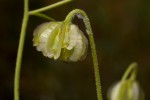
Photo: Bart Wursten
Kopje Tops, Mavhuradonha Wilderness Area
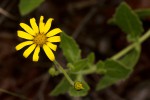
Photo: Bart Wursten
Kopje Tops, Mavhuradonha Wilderness Area
Detailed records: Display species records QDS maps by: Google Maps Point records by Google Maps
Species details: Click on each item to see an explanation of that item (Note: opens a new window)
| Synonyms: |
Tripteris goetzei O.Hoffm. Tripteris gossweileri Mattf. Tripteris gweloensis Mattf. Tripteris monocephala Oliv. & Hiern Tripteris rhodesica R.E.Fr. |
| Common names: | |
| Frequency: | |
| Status: | Native |
| Description: |
Perennial herb, up to 70 cm. Leaves grey-green, sessile or with very short petioles, glandular hairy, oblong-elliptic; margin toothed. Capitula solitary, terminal on stems and branches, yellow, usually tinged with purple on the back. Fruits nodding on the long peduncles, triangular, winged, flushed with purple when fresh. |
| Type location: |
Malawi |
| Notes: | |
| Derivation of specific name: | monocephalum: one-headed |
| Habitat: | In grassland and woodland. |
| Altitude range: (metres) | 1000 - 2400 m |
| Flowering time: | |
| Worldwide distribution: | Angola, DR Congo, Ethiopia, Tanzania, Malawi, Mozambique, Zambia and Zimbabwe. |
| FZ divisions: | N,Z,T,MS |
| Growth form(s): | Perennial. |
| Endemic status: | |
| Red data list status: | |
| Insects associated with this species: | Rhodogastria amasis (Food plant) |
| Spot characters: | Display spot characters for this species |
| Literature: |
Baumann, G. (2005). Photographic Guide to Wildflowers of Malawi Wildlife and Environmental Society of Malawi Pages 166 - 167. (Includes a picture). Burrows, J.E. & Willis, C.K. (eds) (2005). Plants of the Nyika Plateau Southern African Botanical Diversity Network Report No. 31 SABONET, Pretoria Page 103. (Includes a picture). Da Silva, M.C., Izidine, S. & Amude, A.B. (2004). A preliminary checklist of the vascular plants of Mozambique. Southern African Botanical Diversity Network Report No. 30 Sabonet, Pretoria Page 33. Figueiredo, E. & Smith, G.F. (2008). Plants of Angola Strelitzia 22 SANBI, Pretoria Page 46. Hind, D.J.N. (2025). Compositae Flora Zambesiaca 6(5) Pages 6 - 8. as Tripteris monocephala (Includes a picture). Mapaura, A. & Timberlake, J. (eds) (2004). A checklist of Zimbabwean vascular plants Southern African Botanical Diversity Network Report No. 33 Sabonet, Pretoria and Harare Page 27. Phiri, P.S.M. (2005). A Checklist of Zambian Vascular Plants Southern African Botanical Diversity Network Report No. 32 Page 32. |
Other sources of information about Osteospermum monocephalum:
Our websites:
Flora of Angola: Osteospermum monocephalumFlora of the DRC: Osteospermum monocephalum
Flora of Malawi: Osteospermum monocephalum
Flora of Tanzania: Osteospermum monocephalum
Flora of Zambia: Osteospermum monocephalum
Flora of Zimbabwe: Osteospermum monocephalum
External websites:
African Plants: A Photo Guide (Senckenberg): Osteospermum monocephalumAfrican Plant Database: Osteospermum monocephalum
BHL (Biodiversity Heritage Library): Osteospermum monocephalum
EOL (Encyclopedia of Life): Osteospermum monocephalum
GBIF (Global Biodiversity Information Facility): Osteospermum monocephalum
Google: Web - Images - Scholar
iNaturalist: Osteospermum monocephalum
IPNI (International Plant Names Index): Osteospermum monocephalum
JSTOR Plant Science: Osteospermum monocephalum
Mansfeld World Database of Agricultural and Horticultural Crops: Osteospermum monocephalum
Plants of the World Online: Osteospermum monocephalum
Tropicos: Osteospermum monocephalum
Wikipedia: Osteospermum monocephalum