Tragia kirkiana
All images: Click on each image to see a larger version and details of the record View selected images
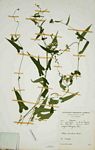
Photo: Bart Wursten
Chesa Purchase Land, Darwin District
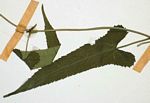
Photo: Bart Wursten
Chesa Purchase Land, Darwin District
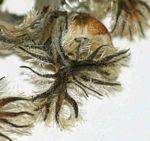
Photo: Bart Wursten
Chesa Purchase Land, Darwin District
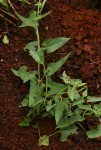
Photo: Bart Wursten
School site Nhancuco, lower slopes Mt Gorongosa.
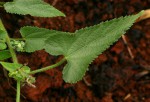
Photo: Bart Wursten
School site Nhancuco, lower slopes Mt Gorongosa.
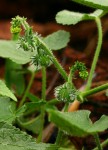
Photo: Bart Wursten
School site Nhancuco, lower slopes Mt Gorongosa.
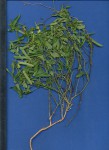
Photo: Sune Holt
Vilankulo, Inhambane, Mozambique
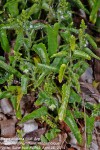
Photo: Sune Holt
Vilankulo, Inhambane, Mozambique
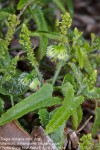
Photo: Sune Holt
Vilankulo, Inhambane, Mozambique
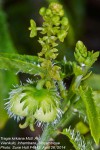
Photo: Sune Holt
Vilankulo, Inhambane, Mozambique
Detailed records: Display species records QDS maps by: Google Maps Point records by Google Maps
Species details: Click on each item to see an explanation of that item (Note: opens a new window)
| Synonyms: |
Tragia angustifolia sensu Benth. Tragia stolziana Pax & Hoffm. |
| Common names: | |
| Frequency: | |
| Status: | Native |
| Description: |
Climbing perennial herb with stinging hairs. Stems up to 3 m long, growing from a woody rootstock, sparsely hairy to almost hairless. Leaves triangular-lanceolate to linear-lanceolate, up to c. 12 cm long, cordate at the 5-7-veined base, often hastate with 2 rounded lobes, sparsely hairy to almost hairless on both surfaces, sometimes bristly on the midrib and veins below; margin sharply dentate. Inflorescences terminal or leaf-opposed, up to 15 cm long on a peduncle up to 15 cm long. Flowers unisexual on the same inflorescence. Calyx of the female flowers densely covered in stiff hairs, consisting of 3 lobes; each lobe palmately divided into 11-13 linear lobes again (see image 3). Fruit 3-lobed, 4 × 8 mm, smooth, with rough hairs on the ribs of the lobes. |
| Type location: |
Mozambique |
| Notes: | This species is very similar to the more common and widespread T. okanyua, differing mainly in the 3-lobed calyx on the female flowes. |
| Derivation of specific name: | kirkiana: named after Dr John Kirk, who accompanied David Livingstone on his Zambezi expedition of 1858 |
| Habitat: | In riverine forest and high-rainfall miombo woodland, often in rocky places. |
| Altitude range: (metres) | |
| Flowering time: | |
| Worldwide distribution: | Kenya, Tanzania, Malawi, Mozambique, Zambia, Zimbabwe, and Mpumalanga, South Africa. |
| FZ divisions: | N,Z,MS |
| Growth form(s): | Climber. |
| Endemic status: | |
| Red data list status: | |
| Insects associated with this species: | |
| Spot characters: | Display spot characters for this species |
| Images last updated: | Thursday 29 January 2009 |
| Literature: |
Burrows, J.E. & Willis, C.K. (eds) (2005). Plants of the Nyika Plateau Southern African Botanical Diversity Network Report No. 31 SABONET, Pretoria Page 149. (Includes a picture). Mapaura, A. & Timberlake, J. (eds) (2004). A checklist of Zimbabwean vascular plants Southern African Botanical Diversity Network Report No. 33 Sabonet, Pretoria and Harare Page 43. Radcliffe-Smith, A. (1996). Euphorbiaceae Flora Zambesiaca 9(4) Pages 235 - 236. |
Other sources of information about Tragia kirkiana:
Our websites:
Flora of Malawi: Tragia kirkianaFlora of Zambia: Tragia kirkiana
Flora of Zimbabwe: Tragia kirkiana
External websites:
African Plants: A Photo Guide (Senckenberg): Tragia kirkianaAfrican Plant Database: Tragia kirkiana
BHL (Biodiversity Heritage Library): Tragia kirkiana
EOL (Encyclopedia of Life): Tragia kirkiana
GBIF (Global Biodiversity Information Facility): Tragia kirkiana
Google: Web - Images - Scholar
iNaturalist: Tragia kirkiana
IPNI (International Plant Names Index): Tragia kirkiana
JSTOR Plant Science: Tragia kirkiana
Mansfeld World Database of Agricultural and Horticultural Crops: Tragia kirkiana
Plants of the World Online: Tragia kirkiana
Tropicos: Tragia kirkiana
Wikipedia: Tragia kirkiana